


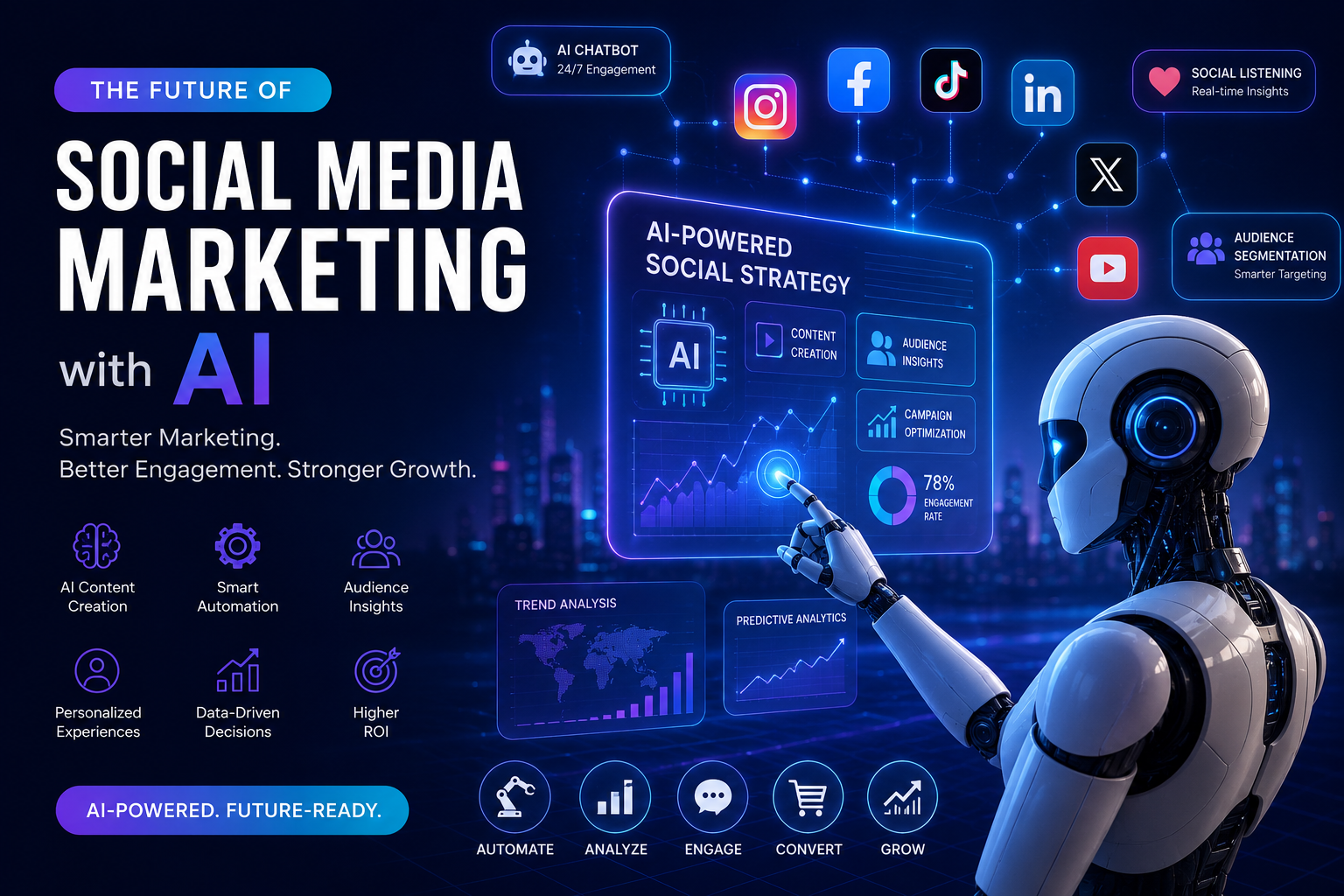
Learn how AI is transforming social media marketing in 2026 with automation, content creation, analytics, and personalized strategies to boost engagement and ROI.
.
How AI Is Transforming Social Media Marketing in 2026: Tools, Trends, and Strategies
Introduction
The world of social media is evolving faster than ever before. What once required hours of manual planning, content creation, audience research, and campaign management can now be accomplished in minutes with the help of artificial intelligence. Businesses of every size—from startups to global enterprises—are embracing Generative AI to streamline workflows, improve engagement, and achieve measurable marketing results.
Today’s consumers expect brands to deliver relevant, personalized, and engaging experiences across multiple social platforms. Meeting these expectations manually is becoming increasingly difficult as audiences demand fresh content, instant responses, and authentic interactions. This is where
Learn how AI is transforming social media marketing with automation, content creation, analytics, and personalized strategies to boost engagement and ROI.
is reshaping the digital landscape.
Artificial intelligence is no longer limited to automation. Modern AI systems combine Large Language Models (LLMs), Natural Language Processing (NLP), Machine Learning, and advanced data analytics to understand customer intent, predict user behavior, and generate highly engaging content tailored to specific audiences.
From AI Content Creation and AI Copywriting to AI Image Generation and AI Video Generation, AI enables marketers to produce high-quality content at scale while maintaining creativity and brand consistency. Instead of replacing marketers, AI acts as an intelligent assistant that helps teams work smarter, make data-driven decisions, and improve campaign performance.
In 2026, successful businesses are using AI to:
- Produce engaging content faster
- Automate repetitive marketing tasks
- Deliver personalized customer experiences
- Improve campaign performance
- Predict audience behavior
- Increase conversions and revenue
- Scale social media operations efficiently
The rapid rise of AI has also changed how people discover information online. Search engines are increasingly powered by AI, making Generative Engine Optimization (GEO) and Google AI Overviews (AIO) important considerations for content creators. Businesses that optimize both their websites and social media presence for AI-driven search experiences will gain a significant competitive advantage.
Whether you manage Facebook Marketing, Instagram Marketing, LinkedIn Marketing, TikTok Marketing, YouTube Shorts, or X (Twitter) Marketing, understanding AI is no longer optional—it’s essential for staying competitive.
In this comprehensive guide, we’ll explore how AI is transforming every aspect of social media marketing, the technologies behind it, the latest tools and trends, and practical strategies you can implement to drive better engagement, stronger brand awareness, and higher ROI.
Understanding AI-Powered Social Media Marketing
Artificial intelligence has transformed social media from a simple communication platform into an intelligent marketing ecosystem capable of learning, adapting, and optimizing campaigns in real time.
Unlike traditional marketing methods that rely heavily on manual decision-making, AI-Powered Social Media Marketing uses intelligent algorithms to analyze millions of data points and identify patterns that humans might overlook. These insights help businesses make smarter marketing decisions while reducing time-consuming manual work.
AI continuously analyzes user interactions, browsing habits, engagement patterns, purchasing behavior, and content preferences. This information enables brands to create more relevant campaigns that resonate with their target audiences.
For example, an online fashion retailer no longer needs to send the same promotional post to every follower. AI can identify customers interested in casual wear, formal clothing, accessories, or seasonal collections and deliver Personalized Content to each audience segment automatically.
This level of personalization dramatically improves user experience while increasing engagement and conversion rates.
Why Businesses Are Investing in AI
Several major shifts in consumer behavior have accelerated AI adoption across industries.
Today’s customers expect:
- Faster responses
- Personalized recommendations
- Relevant advertisements
- High-quality visual content
- Instant customer support
- Consistent brand experiences
Meeting these expectations manually is expensive and often impossible for growing businesses.
AI bridges this gap by helping marketing teams automate repetitive tasks while focusing on strategy and creativity.
Some of the biggest advantages include:
Faster Content Production
Creating social media content traditionally required designers, writers, editors, and marketers working together.
Now, AI Content Creation tools assist with:
- Writing captions
- Creating blog summaries
- Generating ad copy
- Producing product descriptions
- Designing social graphics
- Creating video scripts
Similarly, AI Copywriting tools help marketers generate multiple content variations optimized for different audiences and platforms.
Visual content has also become easier to produce using AI Image Generation, allowing businesses to create custom graphics, product mockups, promotional banners, and campaign visuals without extensive design experience.
Video, now the most engaging content format across social platforms, is benefiting from AI Video Generation, enabling marketers to produce short promotional videos, explainers, and social clips in a fraction of the time required by traditional production methods.
The Technologies Behind AI Marketing
Several powerful technologies work together to make modern AI marketing possible.
Large Language Models (LLMs)
Large Language Models (LLMs) are advanced AI systems trained on vast amounts of text. They understand context, generate human-like language, answer questions, summarize information, and assist marketers in creating high-quality content.
These models power many AI writing assistants used for blogs, advertisements, customer support, and social media management.
Natural Language Processing (NLP)
Natural Language Processing (NLP) enables AI to understand human language rather than simply recognizing keywords.
NLP allows AI to:
- Interpret customer comments
- Understand user intent
- Analyze conversations
- Detect emotions
- Identify trending topics
- Improve customer interactions
For social media marketers, NLP helps create content that better aligns with audience interests while improving communication quality.
Machine Learning
Machine Learning enables AI systems to improve automatically over time.
Rather than relying solely on predefined rules, machine learning algorithms continuously learn from campaign performance, customer interactions, and engagement data.
As more information becomes available, AI becomes increasingly accurate in predicting which content, advertisements, and strategies are most likely to succeed.
This continuous learning process is one of AI’s greatest strengths.
Prompt Engineering: Getting Better Results from AI
One of the most valuable skills in AI-powered marketing is Prompt Engineering. Instead of simply asking an AI tool to “write a social media post,” marketers can craft detailed prompts that specify the audience, tone, platform, campaign objective, call to action, and desired output.
For example, a well-designed prompt can instruct an AI model to create three Instagram captions for a new product launch, each optimized for engagement and including relevant hashtags. By refining prompts, marketers consistently receive more accurate, brand-aligned, and conversion-focused content.
As AI tools become more capable, Prompt Engineering is emerging as a core marketing skill that helps businesses maximize the value of Generative AI while maintaining quality and consistency across campaigns.
Why AI Delivers Better Marketing Results
The true strength of AI lies in its ability to combine creativity with data.
Instead of making decisions based on assumptions, AI analyzes millions of interactions before recommending the best course of action.
This helps marketers:
- Understand audience preferences
- Create more engaging content
- Improve campaign performance
- Increase conversions
- Reduce advertising costs
- Save valuable time
AI also reduces human error while enabling marketing teams to focus on innovation, storytelling, and strategic planning rather than repetitive operational tasks.
As competition on social media continues to intensify, businesses that integrate AI into their workflows are better positioned to deliver meaningful customer experiences, adapt to changing trends, and achieve sustainable growth.
How AI Is Transforming Social Media Marketing in 2026: Tools, Trends, and Strategies
In Part 1, we explored the foundations of Generative AI, Large Language Models (LLMs), Natural Language Processing (NLP), Machine Learning, and Prompt Engineering, and how these technologies are changing the way brands approach social media.
Now, let’s dive into the practical applications of AI that are helping businesses automate workflows, personalize customer experiences, and maximize marketing performance.
AI Automation: The Backbone of Modern Social Media Marketing
One of the biggest challenges marketers face today is managing multiple social media platforms while consistently publishing high-quality content. Creating posts, responding to comments, analyzing performance, and scheduling campaigns manually can quickly become overwhelming.
This is where Social Media Automation has become a game changer.
Instead of performing repetitive tasks manually, AI-powered platforms automate daily marketing operations while allowing marketers to focus on creativity and strategic decision-making.
Automation doesn’t replace marketers—it enhances their productivity.
Modern AI systems can:
- Schedule posts automatically
- Recommend the best posting times
- Reply to common customer questions
- Monitor brand mentions
- Analyze campaign performance
- Generate weekly reports
- Suggest trending topics
- Recommend content improvements
The result is a faster workflow, improved consistency, and better campaign performance.
Marketing Automation Is Becoming Smarter
Traditional Marketing Automation focused primarily on sending scheduled emails or publishing content at predefined times.
Today’s AI-driven automation is far more intelligent.
Modern systems continuously analyze customer interactions and automatically adjust marketing campaigns based on user behavior.
For example:
If a customer frequently watches your Instagram Reels but rarely clicks your Facebook ads, AI automatically shifts marketing efforts toward Instagram while reducing unnecessary ad spend elsewhere.
This dynamic optimization significantly improves marketing efficiency.
Businesses can also automate:
- Lead nurturing
- Product recommendations
- Customer follow-ups
- Promotional campaigns
- Seasonal offers
- Customer onboarding
- Loyalty campaigns
Instead of following fixed rules, AI continuously learns from campaign results and improves future recommendations.
AI Content Scheduling Is More Than Posting at the Right Time
Publishing content consistently is essential for maintaining audience engagement.
However, simply scheduling posts isn’t enough.
Modern AI Content Scheduling tools analyze:
- Audience activity
- Historical engagement
- Platform algorithms
- Industry trends
- Geographic locations
- Time zones
- Device usage
- Seasonal behavior
Rather than using generic “best time to post” recommendations, AI identifies the exact moments when your audience is most likely to interact with your content.
This dramatically improves:
- Reach
- Engagement
- Shares
- Click-through rates
- Website traffic
Businesses using AI scheduling often see stronger performance without increasing publishing frequency.
Building an AI-Powered Content Calendar
Planning content several weeks in advance used to require hours of brainstorming.
Today, an AI-Powered Content Calendar can generate an entire month’s content strategy within minutes.
These intelligent systems analyze:
- Industry trends
- Seasonal events
- Customer interests
- Competitor activity
- Historical engagement
- Search behavior
AI then recommends:
- Educational posts
- Promotional campaigns
- Short-form videos
- Customer success stories
- Polls
- Product launches
- Industry news
- Holiday campaigns
Rather than guessing what to publish next, marketers receive data-driven recommendations backed by historical performance.
The result is a more consistent publishing schedule and stronger audience engagement.
AI Social Media Management Is Revolutionizing Daily Operations
Managing several social media accounts manually becomes increasingly difficult as businesses grow.
AI Social Media Management platforms centralize multiple workflows into one intelligent dashboard.
Instead of switching between platforms, marketers can:
- Publish content
- Monitor engagement
- Track conversations
- Respond to comments
- Analyze campaign performance
- Generate reports
- Monitor competitors
- Schedule future campaigns
AI also prioritizes urgent customer conversations, helping brands respond faster to important issues.
This significantly improves productivity while maintaining a consistent customer experience.
Personalized Content Is the Future of Marketing
Modern consumers expect brands to understand their interests.
Generic content no longer delivers the same engagement it once did.
Using AI, businesses now create Personalized Content for different customer segments.
Instead of publishing identical posts to every follower, AI tailors messaging based on:
- Interests
- Purchase history
- Browsing behavior
- Demographics
- Geographic location
- Previous engagement
- Device usage
For example, an online fitness company may show:
- Weight-loss programs to beginners
- Strength training to experienced athletes
- Yoga content to wellness-focused users
This personalized approach increases customer satisfaction while improving conversions.
Audience Segmentation Is Becoming More Intelligent
Traditional customer segmentation grouped audiences using broad categories like age or location.
AI introduces much deeper Audience Segmentation.
Modern algorithms identify groups based on:
- Shopping habits
- Lifestyle preferences
- Engagement behavior
- Content interests
- Purchase intent
- Brand loyalty
- Online activity
This allows marketers to deliver far more relevant campaigns.
For example, instead of targeting “women aged 25–40,” AI can identify:
- First-time buyers
- Returning customers
- High-value shoppers
- Discount seekers
- Premium customers
These insights lead to more effective campaigns and higher conversion rates.
Hyper-Personalization Creates Better Customer Experiences
While personalization tailors content for audience groups, Hyper-Personalization focuses on individual users.
AI analyzes real-time customer behavior and instantly adjusts recommendations.
Examples include:
- Personalized product suggestions
- Dynamic landing pages
- Individualized email campaigns
- Customized advertisements
- Personalized video recommendations
Customers increasingly expect brands to anticipate their needs.
AI makes this possible at scale.
Understanding Customer Behavior Through AI
Every customer interaction generates valuable data.
AI performs detailed Customer Behavior Analysis by studying:
- Page visits
- Click patterns
- Purchase history
- Watch time
- Scrolling behavior
- Content preferences
- Device usage
- Shopping frequency
These insights help marketers identify which content drives engagement and which campaigns need improvement.
Rather than relying on assumptions, businesses make informed decisions backed by data.
Sentiment Analysis Helps Brands Understand Public Opinion
Millions of conversations occur daily across social media.
Reading every comment manually isn’t possible.
Using Sentiment Analysis, AI determines whether customer conversations express:
- Positive opinions
- Negative feedback
- Neutral discussions
Businesses can quickly identify:
- Customer satisfaction
- Product complaints
- Brand advocates
- Emerging issues
- Viral trends
This enables faster decision-making and proactive customer support.
Social Listening Provides Competitive Intelligence
While sentiment analysis focuses on emotions, Social Listening goes much further.
AI continuously monitors:
- Brand mentions
- Industry discussions
- Competitor campaigns
- Trending hashtags
- Customer questions
- Market trends
Businesses gain valuable insights into what customers actually care about.
For example, if competitors begin receiving complaints about shipping delays, another company can emphasize faster delivery in its own campaigns.
This real-time intelligence creates a competitive advantage.
AI Chatbots Are Improving Customer Service
Consumers increasingly expect immediate responses.
Waiting several hours for customer support is no longer acceptable.
Modern AI Chatbots provide instant assistance 24/7.
They answer frequently asked questions, recommend products, collect leads, schedule appointments, and even process simple customer requests.
Because they continuously learn from interactions, chatbot responses improve over time.
This reduces support costs while increasing customer satisfaction.
Conversational AI Makes Interactions Feel Human
Unlike basic chatbots that follow scripted responses, Conversational AI understands context, intent, and natural language.
Powered by LLMs and NLP, these systems can:
- Hold natural conversations
- Understand follow-up questions
- Recommend products
- Troubleshoot issues
- Guide customers through purchases
This creates a smoother customer journey and strengthens trust.
Community Management at Scale
Building an engaged audience requires active Community Management.
AI assists community managers by:
- Prioritizing important conversations
- Flagging inappropriate content
- Detecting spam
- Highlighting unanswered questions
- Identifying loyal followers
Instead of replacing human interaction, AI ensures that no valuable customer conversation is missed.
Brands can maintain active, healthy communities while reducing moderation workload.
Content Personalization Drives Higher Engagement
Consumers engage more with content that feels relevant to them.
AI enables advanced Content Personalization by automatically adjusting:
- Headlines
- Images
- Captions
- Calls-to-action
- Product recommendations
- Promotional offers
Even a small improvement in relevance can significantly increase engagement, click-through rates, and conversions.
AI Is Reinventing Digital Advertising
Paid advertising has become increasingly competitive.
AI now optimizes every stage of campaign creation.
Dynamic Creative Optimization (DCO)
Dynamic Creative Optimization (DCO) automatically combines different headlines, visuals, calls-to-action, and audience segments to determine the highest-performing ad combinations.
Instead of manually testing dozens of creatives, AI continuously identifies winning combinations in real time.
AI Ad Creative
Creating multiple ad variations used to require significant design resources.
Today, AI Ad Creative platforms generate:
- Headlines
- Product visuals
- Ad copy
- Calls-to-action
- Banner concepts
- Video ads
Marketers can test more creative variations while reducing production time.
AI Advertising
Modern AI Advertising platforms optimize:
- Bid strategies
- Budget allocation
- Audience targeting
- Creative selection
- Campaign delivery
Rather than manually adjusting campaigns, AI continuously improves performance based on live data.
Campaign Optimization
Successful marketers continuously improve their campaigns.
AI accelerates Campaign Optimization by automatically identifying:
- Low-performing ads
- Budget inefficiencies
- Audience fatigue
- Creative saturation
- Conversion bottlenecks
This enables faster improvements and stronger ROI.
Smart Audience Targeting
One of AI’s greatest strengths is Smart Audience Targeting.
Instead of relying on broad demographics, AI identifies users most likely to engage or purchase based on behavioral signals, interests, and intent. This precision reduces wasted ad spend and improves campaign efficiency.
Lookalike Audience Modeling
AI also enhances customer acquisition through Lookalike Audience Modeling.
By analyzing the characteristics of your highest-value customers, AI can identify new users with similar behaviors and interests. This helps brands expand their reach while maintaining high conversion potential.
Engagement Prediction
Before a campaign even launches, AI can estimate likely outcomes using Engagement Prediction.
By evaluating historical performance, audience preferences, content type, and timing, AI forecasts expected likes, shares, comments, and click-through rates. Marketers can then refine campaigns before investing additional budget.
How AI Is Transforming Social Media Marketing in 2026: Tools, Trends, and Strategies
In the previous sections, we explored the technologies behind artificial intelligence and how AI is transforming content creation, advertising, personalization, automation, and audience targeting.
In this final part, we’ll examine how AI is helping businesses measure marketing performance, optimize customer experiences, prepare for AI-powered search, and build sustainable marketing strategies for the future.
Measuring Success with AI-Powered Analytics
Creating great content is only half the battle. Understanding what works—and why—is what separates successful brands from the competition.
Modern AI platforms don’t simply collect data; they transform it into actionable insights that marketers can use to improve every campaign.
Performance Analytics
Performance Analytics has evolved beyond basic metrics like likes and followers.
Today’s AI platforms analyze:
- Audience engagement patterns
- Content effectiveness
- Conversion paths
- Campaign profitability
- Customer retention
- Brand growth trends
Instead of manually compiling reports, AI automatically highlights strengths, weaknesses, and opportunities for improvement.
For example, if educational carousel posts consistently outperform promotional content, AI recommends increasing that content format.
Social Media Analytics
Advanced Social Media Analytics provide a complete picture of campaign performance across every platform.
Businesses can measure:
- Audience growth
- Post engagement
- Video completion rates
- Link clicks
- Website traffic
- Customer interactions
More importantly, AI identifies why certain content succeeds, allowing marketers to replicate successful strategies.
Real-Time Analytics
Marketing decisions are most valuable when they’re made quickly.
With Real-Time Analytics, brands can monitor campaigns as they happen.
If an advertisement begins underperforming, AI immediately recommends:
- Adjusting the audience
- Changing creative assets
- Increasing or reducing budget
- Modifying bidding strategies
Real-time optimization prevents wasted spending and maximizes campaign performance.
Measuring Revenue Instead of Vanity Metrics
Many businesses still focus on likes and follower counts.
Successful marketers focus on revenue.
ROI Measurement
Every marketing investment should produce measurable business results.
AI simplifies ROI Measurement by connecting advertising costs with actual outcomes.
Businesses can evaluate:
- Revenue generated
- Cost per lead
- Customer acquisition costs
- Profit margins
- Marketing efficiency
This helps marketers confidently allocate budgets toward the highest-performing campaigns.
Conversion Tracking
AI improves Conversion Tracking by monitoring customer actions across multiple touchpoints.
Instead of only tracking purchases, businesses can measure:
- Newsletter sign-ups
- Quote requests
- Product downloads
- Demo bookings
- App installations
- Form submissions
This complete customer view allows marketers to identify where prospects convert—and where they drop off.
Predictive Lead Generation
Rather than waiting for potential customers to express interest, AI proactively identifies high-intent prospects through Predictive Lead Generation.
By analyzing customer behavior, search intent, engagement history, and demographic patterns, AI identifies users who are most likely to become customers.
Sales teams spend less time chasing unqualified leads and more time closing deals.
AI Recommendation Engines Drive Engagement
Consumers expect personalized experiences.
An AI Recommendation Engine studies browsing behavior, purchase history, and engagement patterns to recommend the most relevant content, products, or services.
Examples include:
- Suggested videos
- Personalized products
- Recommended blog articles
- Relevant social posts
- Customized offers
These recommendations increase engagement while encouraging repeat visits and higher customer satisfaction.
Identifying Trends Before Competitors
Speed has become a competitive advantage.
Trend Analysis
AI continuously performs Trend Analysis by monitoring:
- Viral conversations
- Emerging hashtags
- Industry news
- Consumer behavior
- Competitor activity
Businesses can capitalize on trends before they become saturated.
Hashtag Optimization
Choosing effective hashtags is no longer guesswork.
AI-powered Hashtag Optimization tools recommend hashtags based on:
- Search popularity
- Audience relevance
- Competition
- Engagement potential
This increases discoverability while improving organic reach.
The Rise of Social Commerce
Consumers increasingly purchase products without leaving social platforms.
Social Commerce combines content, engagement, and purchasing into one seamless experience.
AI improves social commerce by:
- Recommending products
- Personalizing shopping experiences
- Predicting purchase intent
- Optimizing product catalogs
- Automating customer support
Brands using AI-driven social commerce often experience higher conversion rates and lower customer acquisition costs.
AI and Influencer Marketing
Influencer marketing continues to grow, but selecting the right creators has traditionally involved manual research.
Influencer Marketing
Modern Influencer Marketing relies heavily on AI to evaluate creators based on:
- Audience quality
- Engagement rates
- Authenticity
- Brand alignment
- Campaign history
This minimizes risk and improves partnership success.
AI Influencer Discovery
Instead of searching manually, AI Influencer Discovery tools analyze millions of creator profiles to identify influencers whose audiences closely match a brand’s target market.
Businesses can filter creators by:
- Industry
- Location
- Audience demographics
- Engagement quality
- Content style
This makes influencer selection faster and more data-driven.
User-Generated Content (UGC)
Consumers trust other consumers more than advertisements.
AI helps brands identify valuable User-Generated Content (UGC) across social platforms, making it easier to repurpose authentic customer experiences into high-performing marketing assets.
UGC improves credibility while strengthening community engagement.
Protecting Brand Reputation with AI
A single negative post can spread rapidly across social media.
AI helps brands respond before small issues become major crises.
Brand Monitoring
Brand Monitoring tools track:
- Mentions
- Reviews
- News coverage
- Customer discussions
- Competitor references
Businesses receive instant alerts whenever important conversations occur.
Online Reputation Management (ORM)
Strong Online Reputation Management (ORM) protects long-term brand value.
AI identifies:
- Negative reviews
- Fake information
- Customer complaints
- Reputation risks
Marketing teams can respond quickly and maintain customer trust.
Brand Sentiment Analysis
Beyond tracking mentions, Brand Sentiment Analysis determines how customers actually feel.
AI categorizes conversations as:
- Positive
- Neutral
- Negative
These insights help businesses improve customer experiences while identifying emerging reputation challenges.
Building Trust Through Responsible AI
As AI becomes more powerful, ethical considerations become increasingly important.
Ethical AI in Marketing
Businesses must ensure Ethical AI in Marketing by avoiding bias, respecting customer rights, and creating transparent experiences.
Responsible AI builds stronger customer relationships and protects long-term brand credibility.
AI Governance
Effective AI Governance establishes clear policies regarding AI usage, accountability, and risk management.
Organizations should regularly review AI outputs to ensure accuracy, fairness, and compliance.
Deepfake Detection
As synthetic media becomes more realistic, Deepfake Detection technologies are helping businesses identify manipulated videos, fake endorsements, and misleading visual content before it damages brand trust.
AI Transparency
Consumers increasingly want to know when they’re interacting with AI.
Practicing AI Transparency—such as clearly disclosing AI-generated content or chatbot interactions—strengthens trust and reinforces authenticity.
Data Privacy
Customer trust depends on responsible data handling.
Businesses using AI should prioritize Data Privacy by collecting only necessary information, protecting customer data, and complying with regulations.
First-Party Data
As third-party cookies continue to disappear, First-Party Data has become one of the most valuable marketing assets.
AI helps businesses organize and activate first-party customer data to deliver personalized experiences while maintaining privacy standards.
Creating Seamless Customer Experiences
Customers interact with brands across many channels.
AI connects these experiences into one cohesive journey.
Multichannel Marketing
Multichannel Marketing uses AI to coordinate messaging across websites, email, mobile apps, and social media, ensuring customers receive consistent communication regardless of where they engage.
Omnichannel Customer Experience
While multichannel focuses on multiple touchpoints, an Omnichannel Customer Experience creates one connected journey where every interaction feels seamless.
AI synchronizes customer data, allowing conversations to continue naturally across different platforms.
Continuous Campaign Improvement
Successful marketing never stands still.
Creative Optimization
AI supports Creative Optimization by testing different headlines, visuals, calls to action, and formats to identify the combinations that generate the strongest engagement and conversions.
A/B Testing
Traditional A/B Testing often compares two versions of a campaign.
AI expands this process by testing dozens of creative combinations simultaneously and automatically selecting the highest-performing variants.
Marketing Intelligence
Modern Marketing Intelligence combines customer insights, competitive analysis, predictive modeling, and market trends into one comprehensive decision-making system.
Marketers gain a clearer understanding of what drives growth and where to invest resources.
Optimizing for the Future of AI Search
Search is changing rapidly.
People increasingly receive answers directly from AI-powered search experiences.
Generative Engine Optimization (GEO)
Generative Engine Optimization (GEO) focuses on creating authoritative, well-structured content that AI assistants can easily understand, summarize, and recommend.
Brands investing in GEO improve their visibility beyond traditional search rankings.
Google AI Overviews (AIO)
Google AI Overviews (AIO) generate AI-powered summaries directly within search results.
Businesses producing comprehensive, trustworthy, and semantically rich content are more likely to appear in these AI-generated answers.
AI Search Optimization
AI Search Optimization extends beyond keywords by emphasizing context, expertise, entity relationships, structured content, and user intent.
Voice Search Optimization
With more users relying on digital assistants, Voice Search Optimization encourages marketers to create conversational content that answers natural-language questions clearly and directly.
Visual Search
Visual Search allows users to discover products and information through images rather than text.
Optimized visuals, descriptive metadata, and AI-generated image tagging improve visibility in visual search experiences.
Understanding the Complete Customer Journey
Successful marketers understand every stage of the buying process.
Customer Journey Mapping
AI-powered Customer Journey Mapping identifies every interaction customers have before making a purchase.
Businesses can optimize each touchpoint to reduce friction and improve conversions.
Customer Lifetime Value (CLV)
Rather than focusing solely on first-time purchases, AI estimates Customer Lifetime Value (CLV), helping businesses invest more effectively in customer retention and long-term profitability.
Conversion Rate Optimization (CRO)
AI enhances Conversion Rate Optimization (CRO) by identifying friction points, recommending design improvements, and personalizing landing pages to increase conversions.
Engagement Rate Optimization
Beyond increasing visibility, AI supports Engagement Rate Optimization by recommending content formats, posting times, and messaging strategies that encourage meaningful audience interaction.
Extending Content Value
Creating great content takes time.
Content Repurposing enables marketers to transform one piece of content into multiple formats, such as blog articles, infographics, podcasts, newsletters, and social media posts, maximizing reach while reducing production effort.
Winning Across Every Social Platform
Different platforms require different strategies.
AI helps marketers tailor content for:
- Short-Form Video Marketing
- Instagram Reels
- YouTube Shorts
- TikTok Marketing
- Facebook Marketing
- LinkedIn Marketing
- X (Twitter) Marketing
AI recommends platform-specific formats, optimal posting times, content lengths, and audience targeting to improve performance across each network.
Building an AI-Powered Social Media Strategy
An effective AI-Powered Social Media Strategy combines automation, personalization, predictive analytics, and human creativity.
Instead of replacing marketers, AI enhances strategic planning by providing deeper insights and faster decision-making.
Content Performance Prediction
Before publishing, AI performs Content Performance Prediction by estimating expected engagement based on historical data, audience preferences, and content characteristics.
This allows marketers to refine content before launch.
Brand Voice Consistency
Maintaining a recognizable identity across multiple platforms can be challenging.
AI helps ensure Brand Voice Consistency by analyzing tone, messaging, vocabulary, and style across every piece of content.
AI-Assisted Decision Making
Rather than relying on assumptions, AI-Assisted Decision Making enables marketing teams to prioritize strategies based on data-driven recommendations, improving confidence and reducing risk.
Marketing Workflow Automation
Finally, Marketing Workflow Automation connects content creation, approvals, scheduling, analytics, reporting, and optimization into one streamlined process.
Teams spend less time on repetitive tasks and more time building innovative campaigns that drive measurable business growth.
Conclusion
Artificial intelligence is no longer a future trend—it is the driving force behind modern social media marketing. From Generative AI, Prompt Engineering, and intelligent content creation to predictive analytics, campaign optimization, AI-powered advertising, and advanced search optimization, AI is transforming how businesses connect with customers.
The brands that succeed in 2026 will not simply adopt AI tools; they will combine AI capabilities with human creativity, strategic thinking, and authentic storytelling. By embracing responsible AI practices, investing in Generative Engine Optimization (GEO), optimizing for Google AI Overviews (AIO), and continually refining campaigns through data-driven insights, businesses can build stronger relationships, improve customer experiences, and achieve sustainable growth.
AI should be viewed as a powerful partner—not a replacement for marketers. Those who learn to balance automation with originality will be best positioned to thrive in the rapidly evolving world of social media marketing.
Follow us on youtube